
Visoki Dečani: A Serbian Treasure in Kosovo

My recent trip grew out of my wish to learn more about the Western Balkans, especially Serbia and Kosovo. I had visited Bosnia and Herzegovina, Croatia, Montenegro, Slovenia, and Greece. This region's tapestry is culturally rich, woven at the crossroads of Roman, Greek, Slavic, and Ottoman civilizations. I specifically wanted to look more closely at Slavic history.

One must-visit site for me was the Visoki Dečani Monastery, a medieval Serbian Orthodox Christian monastery. Situated in the beautiful Deçan Canyon, it is easily accessible by road, about 1.2 miles from Deçan Town.
Visoki Dečani remains under the protection of NATO-led KFOR peacekeeping troops, a symbol of the region's troubled history. We were required to surrender our passports at the security checkpoint before entering the monastery grounds.
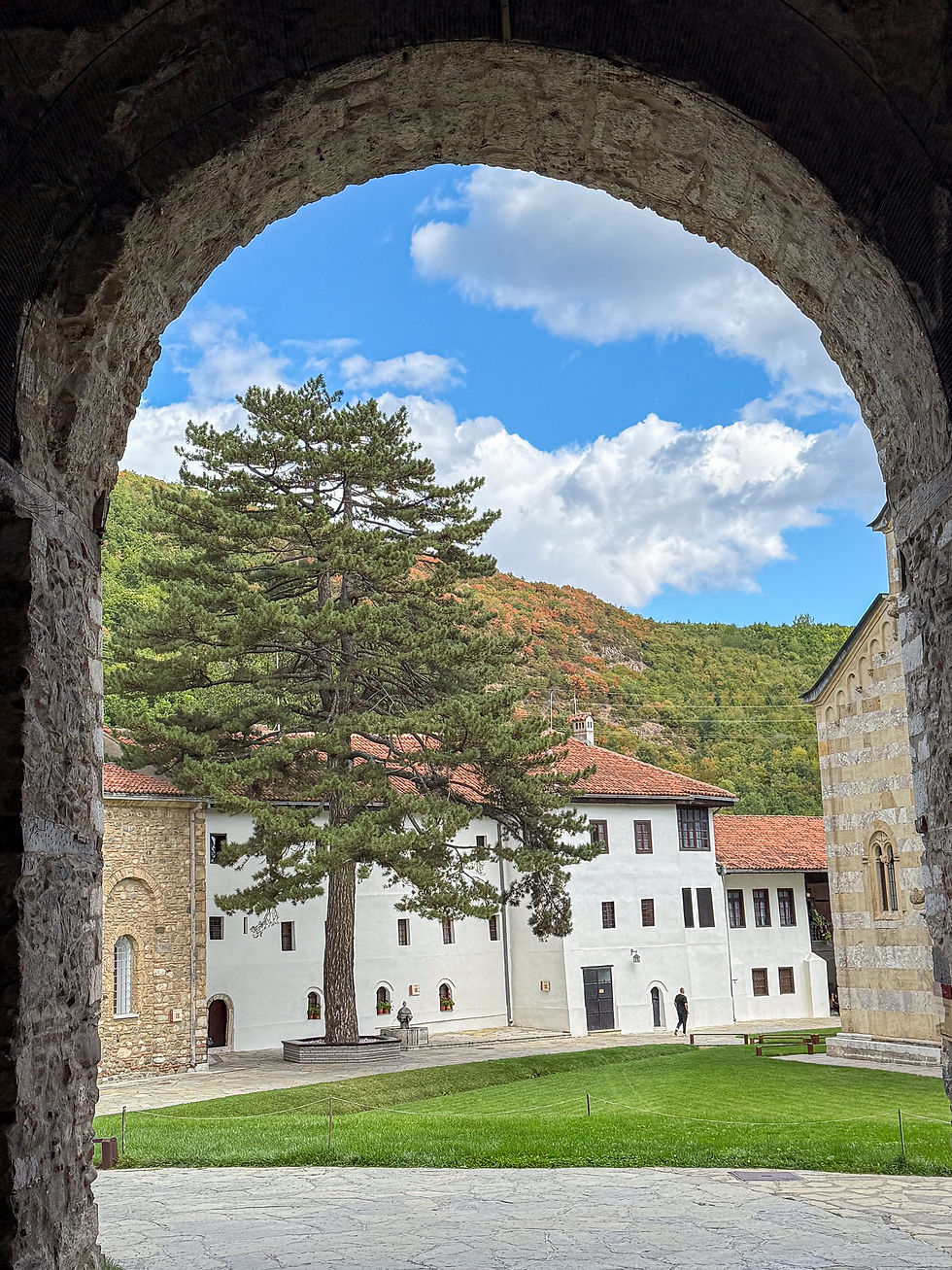
When I walked through the medieval doors into the monastery courtyard, I was immediately impressed. First, the calm, natural beauty of the trees and mountains struck me; then I contemplated the church before me. Its exterior was striking; I fell a little in love with the alternating bands of polished red-purple and light-yellow marble, all sourced from a nearby medieval quarry.
Architectural details of Visoki Dečani: its domed roof, medieval stone carvings, and richly decorated entrance
It is both the largest and best-preserved medieval church in the Balkans. It earns its prefix Visoki, meaning high, from its height of 118 feet; remember, it was built in the 14th century. The church also features a rare combination of Romanesque arched portals and stone relief carvings, which combined with Eastern Byzantine art, make it unique and mesmerizing. Fra Vita, a Franciscan friar from Kotor, led its construction; he masterfully blended coastal Western architecture with the layout required for an Orthodox monastery.
The beauty doesn't stop with the exterior; the monument houses beautifully preserved Byzantine frescoes, over 1000 in number. Seeing these 14th-century wall paintings, together with the original marble iconostasis and floors, was breathtaking. The extraordinary architectural and artistic survival earned Visoki Dečani UNESCO World Heritage Status in 2004.


The monastery's construction began in 1327 under Serbian King Stefan Uroš III (later known as Stefan Dečanski), who ruled the Kingdom of Serbia from 1321 to 1331. Born into a royal family around 1276, he was the son of King Stefan Milutin, who ruled Serbia from 1282 to 1321.
Despite his royal status, his life was turbulent. Around age ten, his father sent him to the Golden Horde as a hostage to help maintain peace between the Serbs and the Tatars. When he returned safely to Serbia four to six years later, his father appointed him governor of Zeta (present-day Montenegro). Later, he rebelled against his father, who subsequently ordered him blinded and exiled to Constantinople. When he was allowed to return to Serbia, he was given control of Budimlje (part of presentMontenegro) because his half-brother, Stefan Konstantin, now ruled Zeta.

Once King Milutin fell ill and died, a civil war broke out, with both brothers claiming the throne. Stefan Uroš III (previously blinded) then showed that he could see. He proclaimed it was a miracle from God. Many believed him and supported him; perhaps he had only been partially blinded. On January 6, 1321, or 1322, Stefan Uroš III was crowned King of Serbia.
Notably, he expanded and strengthened the Kingdom of Serbia and commissioned this wonderful monastery and church. He is remembered as a good, noble person and was canonized by the Serbian Orthodox Church as a saint. His body rests at the Visoki Dečani monastery, where it is honored. His son, Stefan Dušan, who overthrew him, led Serbia to its territorial and political peak, transforming the kingdom into the Serbian Empire.

Centuries-old Byzantine frescoes and religious treasures inside Visoki Dečani Monastery
What a rich source of Serbian religious and historical information and artifacts. Serbian Orthodox Churches were the first place I saw ancestral trees of the founding families in fresco form on the church walls (pictured above left). I was intrigued by the mix of religious frescoes and icons alongside historical events.
This church serves as the mausoleum of several historical figures; the most prominent of these is its founder, Saint King Stefan Decanski (pictured center above). His beautifully carved sarcophagus is placed prominently within the church.

We had the morning to ourselves at this remarkable monastery, with a knowledgeable local guide bringing its centuries of history to life. As a large tour group arrived just as we were leaving, I felt especially fortunate to have experienced its beauty and history in such peaceful surroundings.


Comments